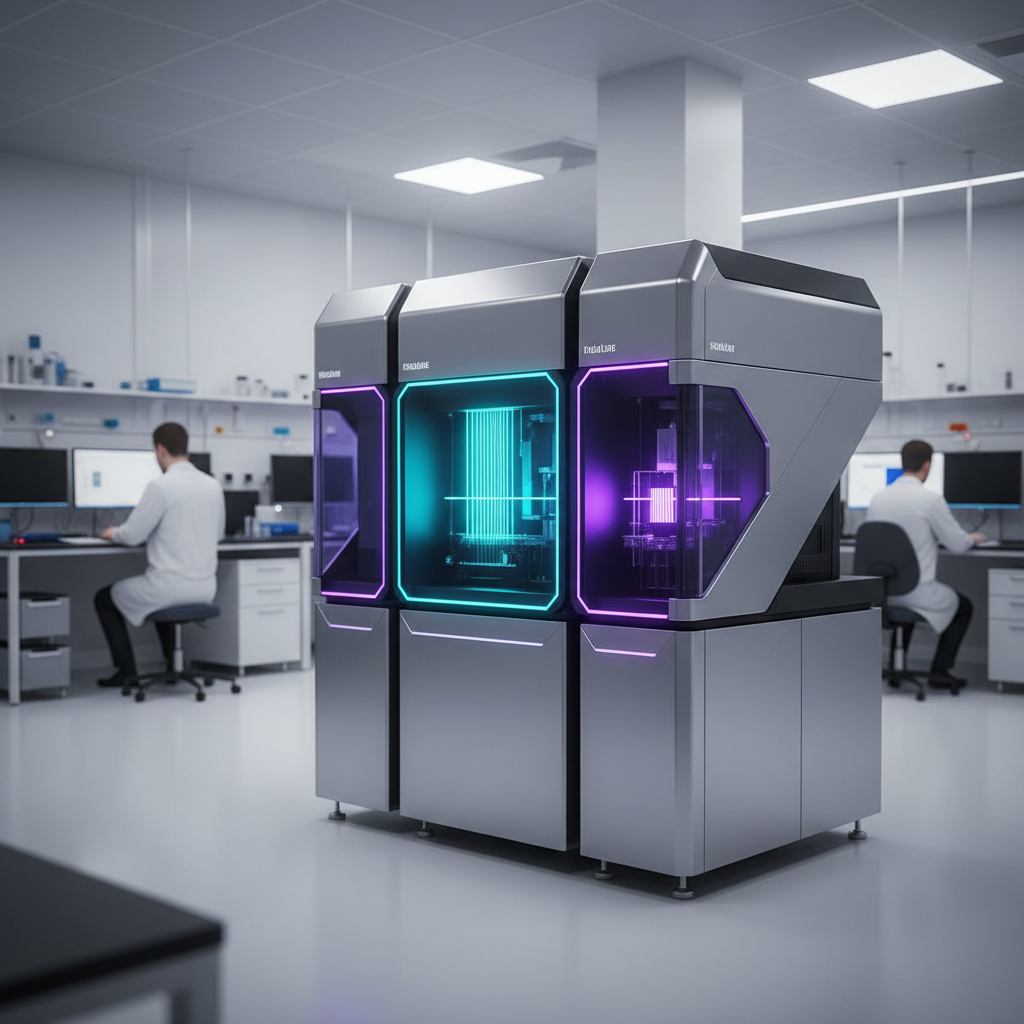
Cell sorter interrogating a focused stream of cells with laser light before droplet deflection
Sorted Pure. Recovered Viable. Ready For Analysis.

Cell Sorters for Every Lab, Line, and Workflow

High-performance cell sorters for immunology labs, single-cell genomics cores, cell-therapy developers, and clinical research facilities. Pure populations at high recovery and viability, from benchtop instruments to high-speed multi-way sorters.

  • Droplet-based FACS and gentle microfluidic platforms
  • Purity, recovery and viability trade-offs explained
  • Benchtop units through 6-way high-speed instruments
  • Buying guidance: lasers, nozzles, biosafety, service

The fundamentals

What a Cell Sorter Does

A cell sorter physically isolates defined cell populations from a mixed suspension. Cells labeled with fluorescent antibodies, dyes or reporter proteins stream single-file past one or more lasers, and the instrument classifies each cell in real time against the gates you draw. Cells that match are separated out and collected; everything else goes to waste. What comes out is not a data file but the cells themselves, ready for culture, sequencing, functional assays or expansion.

That is the line between an analyzer and a sorter. A flow cytometry analyzer measures every cell and discards them all: its product is information. A sorter measures the same way and then acts on the measurement, recovering the populations you asked for. That single difference changes the engineering, the biosafety picture and the price class of the instrument.

Every sort is judged on three numbers: how clean the sorted fraction is, how much of the target you actually recovered, and how alive the cells are when they land in the tube. The three pull against each other, and instrument setup is largely the art of choosing which one to favor for the experiment at hand.

Analyzer or sorter?

If the experiment ends with a plot, an analyzer is enough. If the experiment continues after cytometry — culturing clones, sequencing a subset, expanding a therapeutic population — you need a sorter, because you need the cells back.

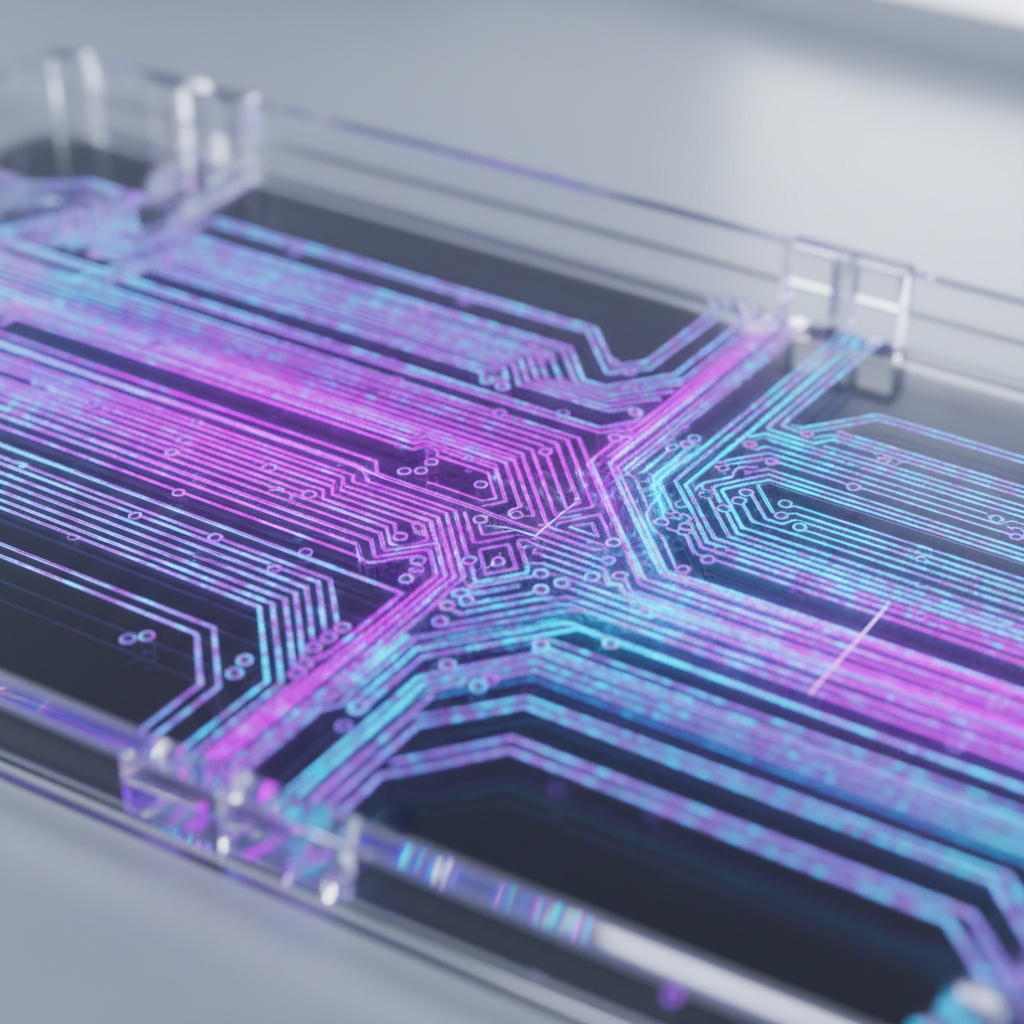
Detail of a cell sorter's flow cell and collection stage in a life-science laboratory
Purity
The fraction of sorted cells that are truly the target population. Verified by re-running an aliquot of the sorted fraction.
Recovery
The share of target cells present in the sample that end up in the collection tube, sometimes quoted as yield.
Viability
The fraction of sorted cells that are alive and functional afterward. Decisive when cells are destined for culture or therapy research.

The mechanics

How Cell Sorting Works

The dominant architecture is droplet-based electrostatic sorting, the mechanism behind classic FACS instruments. It turns a continuous stream of cells into charged droplets and steers each one individually.

  1. Hydrodynamic focusing lines the cells up

    The sample is injected into a faster-moving sheath fluid, which squeezes it into a narrow core so cells pass the measurement point in single file at a consistent position and speed.

  2. Lasers interrogate each cell

    One or more lasers intersect the stream. Each passing cell scatters light, giving size and granularity information, and excites whatever fluorophores it carries.

  3. Detectors classify the cell against your gates

    Scatter and fluorescence signals are captured, compensated or unmixed, and compared against the gating logic in real time. In microseconds the electronics decide: target, non-target or ambiguous.

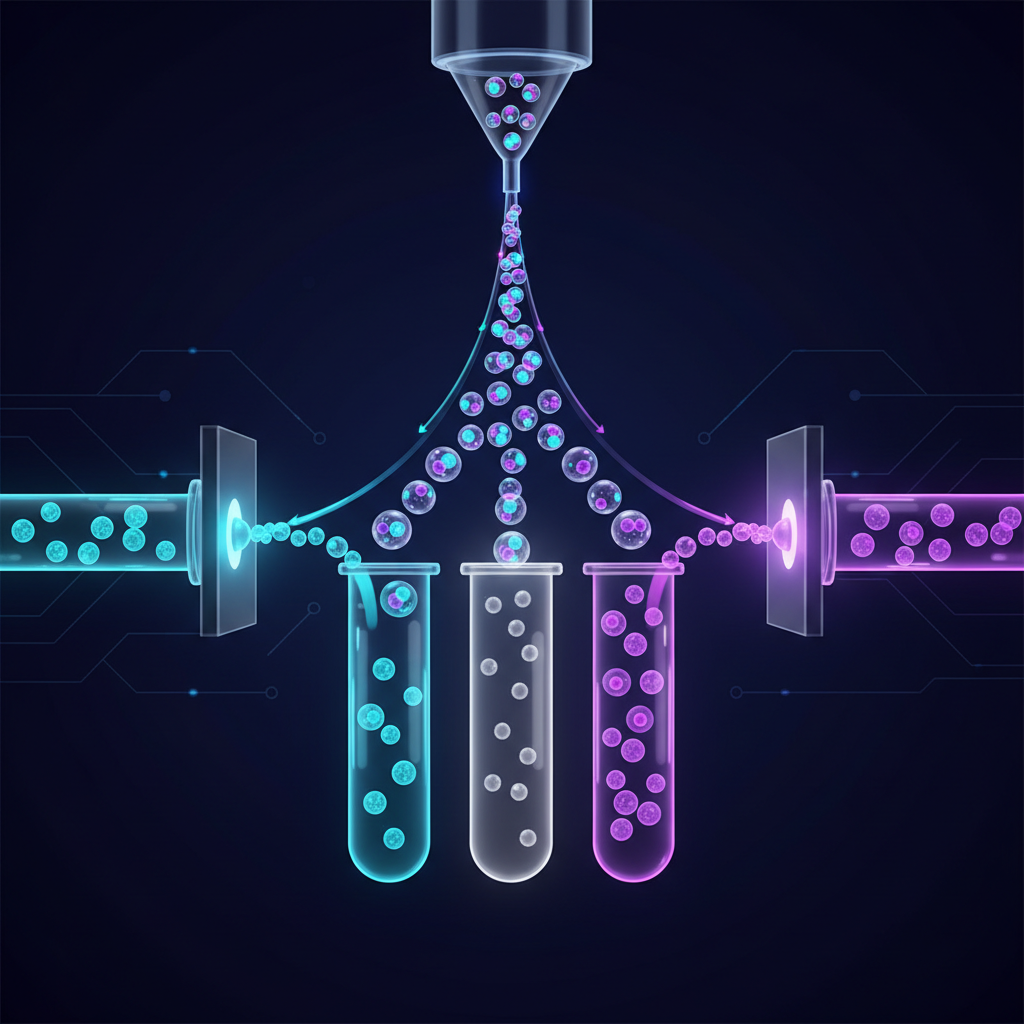
  4. The stream is broken into droplets

    A piezoelectric element vibrates the nozzle at a fixed frequency, so the jet breaks into a train of uniform droplets at a precisely known point below the interrogation site.

  5. Droplets carrying targets are charged

    The instrument times each cell's arrival at the break-off point. If the droplet forming there contains a wanted cell, the stream is given an electrical charge at exactly that instant, which the departing droplet carries away.

  6. Deflection plates steer the droplet home

    Charged droplets pass between high-voltage plates and are deflected left or right into collection tubes or plate wells, with different charge levels enabling 4-way and 6-way sorting. Uncharged droplets fly straight into waste.

Diagrammatic view of droplet-based cell sorting: focused stream, laser interrogation, droplet charging and deflection into collection tubes

Microfluidic sorting: the gentler route

Chip-based sorters make the same keep-or-discard decision inside an enclosed microfluidic cartridge, diverting cells with mechanisms such as micro-valves or acoustic switching instead of charged droplets in open air. Pressures are lower, there is no aerosol-generating jet, and single-use sterile fluidic paths are standard. Throughput is lower than droplet sorting, which is the price of the gentleness.

Magnetic pre-enrichment: a complement, not a replacement

Magnetic separation with antibody-conjugated beads (MACS-style) pulls a marker-positive or marker-negative fraction out of a bulk sample in minutes. It cannot gate on multiple parameters or deliver single cells, but as a first pass it debulks the sample so the sorter spends its time on a pre-enriched population — the standard play for rare targets.

Platforms

Types of Cell Sorters

Four broad classes cover the market. The right one depends on who operates the instrument, how fragile the cells are, and whether the output is a bulk population or one cell per well.

High-Speed Droplet Sorters

Core-facility workhorses

  • Multiple lasers and large detector arrays for complex multi-color panels.
  • 4-way and 6-way simultaneous sorting at tens of thousands of events per second.
  • Rare-event and large-volume work; typically run by dedicated, trained operators.

Benchtop Cell Sorters

Sorting inside your own lab

  • Compact footprint and simplified, largely automated setup and drop-delay calibration.
  • Designed for individual labs rather than shared cores, with walk-up usability.
  • Fewer parameters than a core instrument, but enough for routine enrichment and cloning.

Microfluidic / Gentle Sorters

Enclosed, low-stress sorting

  • Cartridge-based fluidics: sterile, single-use paths with no carryover between samples.
  • Low pressures and no open droplet stream, sparing sensitive and fragile cell types.
  • A natural fit for sterility-critical and GMP-adjacent cell processing work.

Specialty & Single-Cell Dispensers

One cell, one well, documented

  • Index sorting records the full phenotype of each individual deposited cell.
  • Single-cell dispensing into 96- and 384-well plates for genomics and cloning.
  • Built for clone outgrowth documentation and plate-based single-cell workflows.

Core facility or your own bench?

The classic home of a cell sorter is the shared cytometry core: one heavily specified droplet instrument, a booking calendar, and an operator who runs sorts all day and keeps the optics and drop delay honest. For demanding panels and rare populations, that expertise is worth as much as the hardware.

Benchtop and microfluidic sorters changed the equation for everyday work. When a lab sorts several times a week, owning a simpler instrument removes the scheduling tax, keeps fragile samples close to the incubator, and reserves core time for the sorts that genuinely need six lasers.

Decide based on who will run the instrument and how often, not on the spec sheet alone.

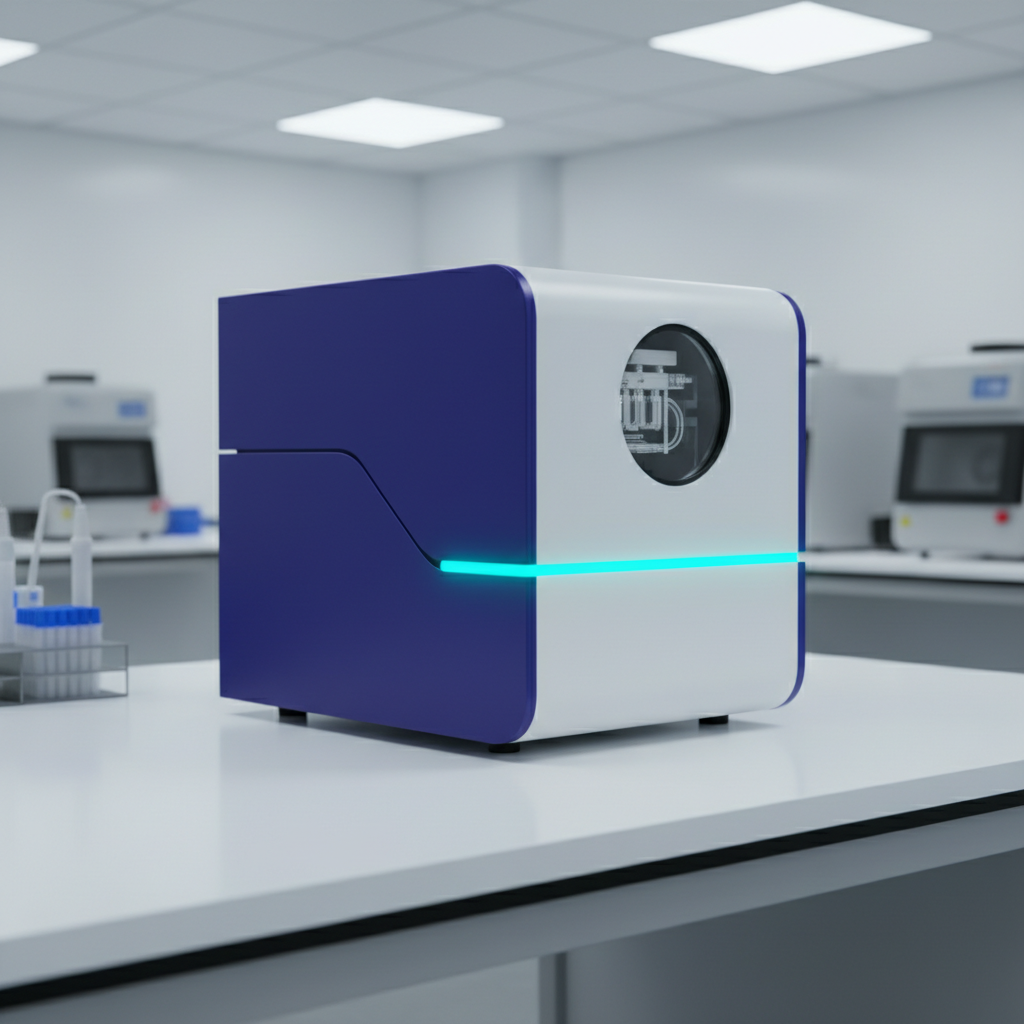
Compact benchtop cell sorter installed in an individual research laboratory

Where sorters earn their keep

Applications

Cell sorting sits upstream of much of modern cell biology. Wherever an experiment needs a defined population rather than a mixed one, a sorter is the instrument that provides it.

Sorted cell populations being prepared for downstream culture and sequencing workflows

Immunophenotyping & immunology

Isolating T-cell, B-cell, NK and myeloid subsets defined by surface-marker combinations, so functional assays are run on the population of interest rather than a bulk PBMC prep.

Single-cell sequencing prep

Enriching viable target cells and stripping out debris, doublets and dead cells before scRNA-seq. Index sorting ties each cell's measured phenotype to its downstream transcriptome.

Cell line development & CRISPR clones

Depositing one transfected or edited cell per well to establish clonal lines, using reporter fluorescence to pick candidates and instrument logs to document monoclonality.

CAR-T & cell-therapy R&D

Selecting transduced cells, characterizing product phenotype during development, and feeding process research where sterile, single-use fluidic paths matter most.

Stem cell research

Separating progenitors and differentiated fractions where gentleness decides whether the sorted cells still function, expand and differentiate as intended downstream.

Microbiome & microbial sorting

Sorting bacteria and yeast by reporter expression, viability dyes or labeled probes, which pushes an instrument's small-particle detection to its limits.

Buying guide

Choosing a Cell Sorter

Spec sheets list dozens of figures. These are the parameters that actually decide whether an instrument fits your cells, your panels and your facility — and the trap that goes with each one.

Key cell sorter selection parameters, what each one governs, and what to watch for
ParameterWhat it governsWhat to watch for
Lasers and detectorsHow many fluorophores you can resolve at once, and therefore how complex your panels can be.Buy for the panels you will run in three years, not the ones you run today. Adding a laser later is rarely simple or cheap.
Sort speed (events/sec)How fast the instrument can process the sample stream, which sets the ceiling on throughput.Headline rates assume ideal samples. Usable speed drops with sticky, clumpy or rare-target samples, and purity mode aborts coincident droplets.
Purity vs recovery modesHow the instrument resolves conflicts when a wanted and unwanted cell share a droplet.Purity modes sacrifice recovery; yield modes sacrifice purity. Confirm the instrument reports what it aborted, so you can account for lost targets.
Nozzle sizesThe range of cell sizes the sorter handles, from lymphocytes up to large or clumpy cell types.The nozzle should be several times the cell diameter. Larger nozzles need lower pressures and slow the sort; check the full nozzle kit, not just the default.
Viability for fragile cellsWhether sensitive types (neurons, hepatocytes, stem cells, transfected lines) survive the sort in usable condition.Ask for viability and functional data on cells like yours, and run your own during the demo. Post-sort survival differs sharply between platforms.
Biosafety and aerosolsWhat sample classes you may legally and safely sort: droplet sorters are aerosol generators.Unfixed human and infectious samples typically require aerosol management or biosafety-cabinet integration, and your institution's biosafety review decides.
Sterility / single-use fluidicsWhether sorted cells can go straight to culture or processing without contamination risk.Cleaning validation on shared fluidics is real workload. Cartridge-based single-use paths remove carryover concerns at a consumable cost per run.
Footprint and facilityBench or floor space, power, ventilation and environmental requirements.High-speed sorters can need dedicated space, aerosol handling and stable temperature. Confirm site requirements before the purchase order, not after.
Service coverageHow quickly the instrument is repaired and re-qualified when it goes down.A sorter feeding time-critical experiments is only as good as the local field-service organization. Ask about response times in your region and loaner policies.
Scientist evaluating cell sorter configuration options in a laboratory setting

Bring these to the demo

  • Your own cells, prepared the way you actually prepare them
  • The largest panel you realistically expect to run
  • Your rarest target, at its real frequency
  • The downstream step: culture, sequencing or functional assay
  • Your biosafety officer's requirements in writing

A sorter that performs beautifully on calibration beads can behave very differently on your samples. The demo exists to find that out before the instrument is on your floor. Honest vendors will welcome it.

Common questions

Cell sorter FAQ

What is the difference between a flow cytometer and a cell sorter?

A flow cytometer analyzer measures cells as they stream past the laser and then sends them to waste: you get data, not cells. A cell sorter makes the same measurements and additionally separates the cells you define, diverting them into tubes, plates or chips while the rest go to waste. Every sorter is a flow cytometer, but only sorters give you the physical population back for culture, sequencing or functional work.

How pure is a sorted population?

It depends on the sort mode, the gating, the abundance of the target and how well the sample was prepared. Well-configured sorts run in a purity mode routinely deliver populations above 95 percent pure, and clean, bright, well-separated targets can go higher. The honest practice is to re-run a small aliquot of the sorted fraction through the instrument afterward and record the measured post-sort purity rather than assuming a number.

Can sorted cells be cultured afterward?

Yes, and post-sort culture is one of the main reasons to sort at all. It requires sterile technique end to end: a cleaned or single-use fluidic path, sterile sheath fluid, collection into medium, and sort settings chosen for the cell type. Larger nozzles and lower pressures are kinder to cells destined for culture, and microfluidic sorters with enclosed sterile cartridges are built around exactly this use case.

What does 4-way or 6-way sorting mean?

The number of populations the instrument can deflect simultaneously into separate collection vessels during a single run. A 4-way sorter can charge droplets to four different trajectories, so four gated populations are collected at once instead of running the sample four times. High-end droplet sorters offer 4-way and 6-way sorting plus deposition into multi-well plates for single-cell work.

Do I need a biosafety cabinet around a cell sorter?

Droplet sorters generate aerosols by design, because they break the sample stream into tens of thousands of droplets per second. When sorting unfixed human material, primary samples or anything infectious, biosafety practice typically calls for an aerosol management system, enclosure of the sort chamber or integration into a biosafety cabinet, along with an institutional risk assessment. Cartridge-based microfluidic sorters keep the sample enclosed and change that calculation. Your biosafety officer and the published cytometry biosafety guidelines are the authority, not the sales brochure.

Should we buy a benchtop sorter or use a core facility?

Core facilities make sense when you need many lasers, rare-event capability and an expert operator a few times a month. A benchtop instrument makes sense when sorting is routine in your own workflow, the panels are moderate, and scheduling around a shared instrument costs more time than the sort itself. Many labs use both: the core for demanding multi-parameter sorts, the benchtop for everyday enrichment.

How are fragile cells handled during sorting?

By reducing the stress the cells experience: a larger nozzle relative to cell size, lower sheath pressure and slower sort rates on droplet instruments; chilled sample and collection stations; collection into protein-supplemented medium; and, for the most sensitive types, microfluidic sorters that avoid high-pressure droplet formation entirely. The right combination is worked out on your own cells, ideally during an instrument demo.

How fast can a cell sorter sort?

High-speed droplet sorters process tens of thousands of events per second. The usable rate is lower than the headline rate, because purity depends on droplets containing exactly one classifiable cell: push the event rate too high and the instrument must abort coincident droplets, costing recovery. Rare targets take time regardless of speed, since the sorter still has to see enough total events to find them. Microfluidic sorters run slower and trade throughput for gentleness and sterility.

Contact

Get a Quote

Request pricing, configuration guidance, or availability for cell sorters. Tell us what you sort, how often, and what happens to the cells afterward, and we will point you in the right direction.

Specifying an instrument

Working out whether a high-speed droplet sorter, a benchtop unit or a microfluidic platform fits your cells and panels.

Comparing platforms

Making sure quotes cover the same lasers, nozzles, biosafety options, consumables and service terms.

Planning the installation

Space, power, aerosol management and biosafety review, and when each needs to be settled.

We use what you submit only to respond to your enquiry. We do not sell or share it. See our privacy notice.